ATTRIBUTION OF THE CHINJI
ATYPICAL “HOMINOID” CANINES
 The atypical upper canines are,
in fact, suid canines. The first evidence of this came when I began to search
through the Siwalik collections at the Geological Survey of Pakistan during the
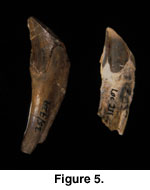
1993 field season. In the suid collections, I found an isolated upper canine
(from a Dhok Pathan locality) that is nearly identical to the atypical Chinji
canines in every respect, differing only in being strongly compressed
bucco-lingually (Figure 5). Like the atypical canines, it has a distinct mesial
wear facet but no distal wear.
The atypical upper canines are,
in fact, suid canines. The first evidence of this came when I began to search
through the Siwalik collections at the Geological Survey of Pakistan during the
1993 field season. In the suid collections, I found an isolated upper canine
(from a Dhok Pathan locality) that is nearly identical to the atypical Chinji
canines in every respect, differing only in being strongly compressed
bucco-lingually (Figure 5). Like the atypical canines, it has a distinct mesial
wear facet but no distal wear.
Why this one canine should have
been placed with the Suidae is unclear. It may be because this was the first
canine of this type discovered by Harvard-GSP team members, who, as noted
earlier, had found a number of genuine Sivapithecus upper canines,
including some still in jaws, and who may have correctly recognized this canine
as non-hominoid. According to its catalogue number, it was found several years
before GSP 23124 and the two atypical canines described by
Raza et al. (1983).
Nevertheless, this canine was itself unassociated, so it was possible that its
assignment to the Suidae was incorrect.
More definitive evidence that
this canine and the atypical canines from the Chinji Formation were those of
suids came during a search of the suid collections at the Kenya National Museums
in 1996. This search produced a skull of the early Miocene suid Hyotherium
dartevellai with the upper canines in place (figured in
Cooke and Wilkinson
1978, figure 22.4). These closely resemble the Siwalik atypical canines
morphologically and also have mesial wear facets but no distal wear facets.
Confirmation came soon after with the publication of
van der Made’s (1996)
monograph on the Listriodontidae, in which are figured and described a number of
female suid canines that are similar or identical to the atypical Siwalik
canines from the Chinji Formation. Figured canines of Bunolistriodon from
Maboko (van der Made 1996, plate 26) and Paşalar (plate 19), and Listriodon
canines from Paşalar (plate 35) and Arroyo del Val IV (plate 38), in
particular closely resemble the atypical Siwalik canines. While a few heavily
worn canines figured by van der Made have both mesial and distal wear facets,
most have only a mesial facet like all the atypical Siwalik canines.
Interestingly, in van der Made’s description of Listriodon
pentapotamiae from the Siwalik Chinji Formation, there is no mention of
female canine morphology, presumably because all of the female canines were in
the hominoid collection. In fact, it is almost surely to this species that the
atypical Chinji canines belong, rather than to the other Chinji suid, the
non-listriodont Conohyus sindiensis.
