SETTING
There are four reef complexes spread over 1000 km2 of shelf from Queen Charlotte Sound to Hecate Strait (map,
Figure 1). The physiography and oceanography of this region are described in
Thomson (1981) and in
Whitney et al. (2005). This part of the western Canadian continental shelf consists of banks that are separated by seaward trending troughs of glacial origin. The shallowest and least dissected part is northern Hecate Strait, mostly at less than 100 m.
 Elsewhere, the main troughs (Moresby, Mitchell's and Goose Island troughs) commonly extend to depths greater than 200 m, at times to 300 m, and their deep ends open on the edge of the shelf. The banks may be at any depth less than 150 m, locally less than 50 m.
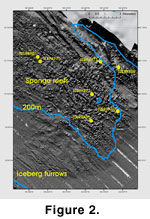
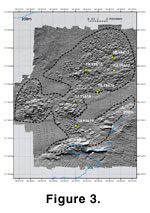
The sponge reefs are all located in the troughs, at depths of between 150 and 250 m. They consist of bioherms of up to 21 m high with steep flanks, and of biostromes of 2-10 m thickness that may stretch for kilometers in all directions (Figure 2,
Figure 3). Individual sponges are commonly more than 1 m high. The sponge population is composed of only eight species of Hexactinellida (three of Hexactinosida, five of Lyssacinosida) and eight species of Demosponges (see
Conway et al. 2005, and
Lehnert et al., in press, for a list of species). Taxonomic work on the demosponge fauna is ongoing so this list must be considered incomplete.
During late glacial times, drifting icebergs ploughed the glacial and glaciomarine deposits covering the continental shelf, thus bringing to the surface coarse clastic material such as boulders and cobbles from the underlying glacial till. After winnowing, these exposed hard surfaces served as anchor points for the first sponges to settle (Conway et al. 1991). Other sponges developed on the top of these first sponges and then spread laterally. In Hecate Strait, the relationship between iceberg furrows and reef distribution is still evident (Figure 3). The earliest sponge reefs probably began to grow around 9000 years BP based on an extrapolated radiocarbon date of 5700±60 years BP (TO-1338) obtained from the lower middle part of a bioherm sampled by a piston core in Moresby Trough (Conway et al. 1991).
 In contrast to the situation in the Jurassic where sponge reef organisms were held together to a great extent by microbially-induced precipitation of carbonate, modern sponges are held in place by a dense envelope of tendrils, which cover the dead sponge substrate and are attached to the reefal buildup by deposits of silica secreted by the young sponge (Krautter et al. 2001;
Krautter et al. 2006).
In contrast to the situation in the Jurassic where sponge reef organisms were held together to a great extent by microbially-induced precipitation of carbonate, modern sponges are held in place by a dense envelope of tendrils, which cover the dead sponge substrate and are attached to the reefal buildup by deposits of silica secreted by the young sponge (Krautter et al. 2001;
Krautter et al. 2006).
The sponges act as baffles, trapping sediments in suspension, which quickly fill up any spaces between individual sponges, and thus stimulate the growth of the bioherm. In contrast, the areas immediately surrounding the bioherms have no sedimentation occurring as the velocity of the currents is too high. The support provided by
the trapped sediment prevents the sponge skeleton framework from collapsing under its own increasing weight. No trace of induration or cementation of the sediment has been observed at any level in the modern reefs.
