INTRODUCTION
 Hexactinellid sponges appeared with the Order Lyssacinosida in the Late Proterozoic. Although the Order Hexactinosida appeared in the Late Devonian, their representatives did not begin to form reefs until the Late Triassic. The maximum extent of reef distribution was in the Late Jurassic, when they spread without discontinuity over hundreds of kilometers and discontinuously for 7000 km on the North side of the Tethys and the early North Atlantic. This reef type declined rapidly during the Cretaceous and was thought to have completely vanished during the Tertiary, at least until
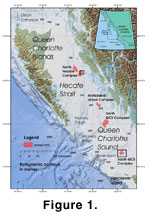
Conway et al. (1991) reported siliceous sponge bioherms living and growing on the continental shelf off western Canada, at depths of 150-250 m in Queen Charlotte Sound and Hecate Strait (Figure 1). Because of the potential for interpreting the widespread but little understood Late Jurassic sponge reefs and of the need for protecting this heretofore unique biotope, the University of Stuttgart, Germany, and the Geological Survey of Canada have undertaken a joint study of these modern sponge reefs. Continued reconnaissance of the western Canadian seafloor has revealed the existence of additional sponge reefs in the Strait of Georgia, between Vancouver Island and the city of Vancouver (Conway et al. 2004).
Hexactinellid sponges appeared with the Order Lyssacinosida in the Late Proterozoic. Although the Order Hexactinosida appeared in the Late Devonian, their representatives did not begin to form reefs until the Late Triassic. The maximum extent of reef distribution was in the Late Jurassic, when they spread without discontinuity over hundreds of kilometers and discontinuously for 7000 km on the North side of the Tethys and the early North Atlantic. This reef type declined rapidly during the Cretaceous and was thought to have completely vanished during the Tertiary, at least until
Conway et al. (1991) reported siliceous sponge bioherms living and growing on the continental shelf off western Canada, at depths of 150-250 m in Queen Charlotte Sound and Hecate Strait (Figure 1). Because of the potential for interpreting the widespread but little understood Late Jurassic sponge reefs and of the need for protecting this heretofore unique biotope, the University of Stuttgart, Germany, and the Geological Survey of Canada have undertaken a joint study of these modern sponge reefs. Continued reconnaissance of the western Canadian seafloor has revealed the existence of additional sponge reefs in the Strait of Georgia, between Vancouver Island and the city of Vancouver (Conway et al. 2004).
The investigation techniques included various methods of echo-sounding (sidescan sonar, Huntec Deeptow Seismic, and swath multibeam bathymetry), close-up observation with remote controlled vehicles and manned mini-submersibles, and seafloor sampling both by bottom grabs and direct sampling using submersibles. About 200 foraminiferal species have been identified from the sponge reef complexes. This includes species found attached or trapped in dead sponge fragments lying in or on the sediment. The foraminifera from the mud (that is, not attached to any sponge fragment) are abundant and representative of the modern Canadian west coast. These taxa will be discussed in a subsequent publication. This paper reports on the foraminifera found attached to sponge fragments recovered by various sampling techniques, both for their affinity and for their mode of occurrence. Late Jurassic sponge reefs are primarily constituted of sponges cemented together by microbially induced carbonates (automicrites) and were colonized by various organisms, including foraminifera. Modern sponge fragments were analyzed with the aim of comparing their foraminiferal content with that of the Jurassic sponge fragments, with the understanding that automicrites are not a reef-cementing agent for the modern reefs.
