


 Elisabete Malafaia. Instituto Dom Luiz, Faculdade de Ciências, Universidade de Lisboa. Campo Grande, 1749-016 Lisboa, Portugal and Grupo de Biología Evolutiva, Facultad de Ciencias, Universidad Nacional de Educación a Distancia (UNED), Avenida de Esparta S/N, 28232 Las Rozas de Madrid, Madrid, Spain (corresponding author). efmalafaia@ciencias.ulisboa.pt
Elisabete Malafaia is a junior researcher at the Instituto Dom Luiz, Faculdade de Ciências, Universidade de Lisboa (FCUL). Her research focuses on the diversity, paleoecology, and evolutionary history of theropod dinosaurs, with expertise in comparative anatomy, phylogenetic systematics, and the stratigraphic and paleoenvironmental interpretation of Mesozoic sequences. She has taught Geology and Vertebrate Paleontology at FCUL and also has experience in the conservation and restoration of vertebrate fossils, as well as in the management of paleontological collections. She is an invited specialist for the Mesozoic paleontological collections of the Museu Nacional de História Natural e da Ciência, Universidade de Lisboa.

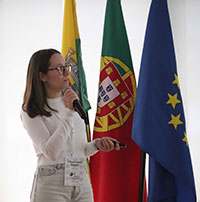 Filipa Batista. Faculdade de Ciências e Tecnologia, Universidade Nova de Lisboa, Campus da Caparica, 2829-516 Caparica, Portugal. filipa.lopes.batista@gmail.com
Filipa Batista graduated in Geology from the Faculdade de Ciências, Universidade de Lisboa and holds a master’s degree in Paleontology from the Faculdade de Ciências e Tecnologia, Universidade Nova de Lisboa. For her master’s dissertation, she investigated wear structures on small theropod teeth from the Upper Jurassic of Andrés (Portugal), contributing to a better understanding of the taxonomic diversity and paleoecological significance of these fossils within the Late Jurassic ecosystems of the Lusitanian Basin.
 Bruno Maggia. Instituto Dom Luiz, Faculdade de Ciências, Universidade de Lisboa. Campo Grande, 1749-016 Lisboa, Portugal and Grupo de Biología Evolutiva, Facultad de Ciencias, Universidad Nacional de Educación a Distancia (UNED), Avenida de Esparta S/N, 28232 Las Rozas de Madrid, Madrid, Spain. BrunoMaggia@gmail.com
Bruno Maggia is a PhD student at the Instituto Dom Luiz / Faculdade de Ciências da Universidade de Lisboa, Portugal. He is studying the evolution and the ecology of theropods by applying morpho-functional approaches.
 Carolina S. Marques. Centro de Estatística e Aplicações, Faculdade de Ciências, Universidade de Lisboa. Campo Grande, 1749-016 Lisboa, Portugal. csmarques@ciencias.ulisboa.pt
Carolina S. Marques is a PhD student at the Centro de Estatística e Aplicações, Universidade de Lisboa, pursuing her PhD at the Departmento de Ciências Matemáticas, Universidade de Lisboa. Her research currently focuses on using different machine learning techniques to help solve problems in palaeontology, for example, classification of isolated theropod teeth and dinosaur footprints.
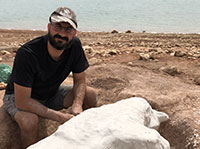 Fernando Escaso. Grupo de Biología Evolutiva, Facultad de Ciencias, Universidad Nacional de Educación a Distancia (UNED), Avenida de Esparta S/N, 28232 Las Rozas de Madrid, Madrid, Spain. fescaso@ccia.uned.es
Fernando Escaso is an Associate Professor at the Science Faculty of the UNED and Researcher of the Evolutionary Biology Group of the UNED. His research focuses on the analysis of the evolutionary history of Mesozoic reptiles and their ecosystems. Specifically, the main lines of the current research are focused on the knowledge of the ornithischian faunistic composition during the Late Jurassic and the Cretaceous of Iberian landmass and its relationships with synchronic Laurasian faunas.
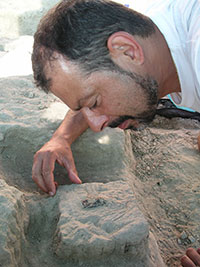 Pedro Dantas. Museu Nacional de História Natural e da Ciência, Universidade de Lisboa, Rua da Escola Politécnica 56, 1250-102 Lisboa, Portugal and Sociedade de História Natural, Apartado 25, 2564-909 Torres Vedras, Portugal. pedromdantas@gmail.com
Pedro Dantas is a senior collaborator researcher at the Museu Nacional de História Natural e da Ciência, Universidade de Lisboa. His research focuses on the diversity, paleoecology, and evolutionary history of tetrapod animals, with expertise in comparative anatomy, phylogenetic systematics, and, from a geological perspective, the stratigraphic and paleoenvironmental interpretation of Mesozoic sequences.
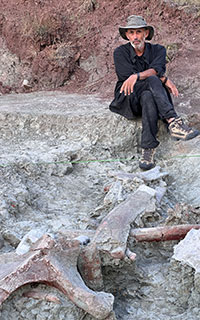 Francisco Ortega. Grupo de Biología Evolutiva, Facultad de Ciencias, Universidad Nacional de Educación a Distancia (UNED), Avenida de Esparta S/N, 28232 Las Rozas de Madrid, Madrid, Spain. fortega@ccia.uned.es
Francisco Ortega is Full Professor of Paleontology at the Faculty of Sciences, UNED (Madrid), where he teaches courses on biodiversity to Environmental Sciences students. He serves as Principal Investigator of the Evolutionary Biology Research Group-UNED, leading research on the evolutionary history of Mesozoic reptiles—particularly crocodiles and dinosaurs—and their ecosystems. His academic output includes more than one hundred publications in scientific and technical journals, with a primary focus on the Upper Jurassic of Portugal, the Lower and Upper Cretaceous of Spain, and the Paleogene of Spain. Beyond research, he has significantly contributed to the development of museum and museographic projects in Spain and Portugal. He has also been actively involved in numerous paleontological research initiatives in Spain, Portugal, Niger, Argentina, and the United States. His fieldwork experience includes participation in nearly one hundred excavations and collaboration on more than twenty national and international research projects.
