


 Long before the group that encompasses all living birds (Neornithes) evolved, survived the end Cretaceous mass extinction (the only dinosaurs to do so), and became the most diverse group of land vertebrates on our planet there was… Enantiornithes!! The first major avian radiation, this group dominated terrestrial ecosystems throughout the entirety of the Cretaceous and their fossil remains have been collected from nearly every continent (absent in Antarctica and yet to be found in continental Africa). These birds were primarily arboreal, like modern passerines, and ranged from tiny hummingbird-size individuals trapped in 100-million-year-old Burmese amber to turkey vulture sized predators that hunted in the Hell Creek Formation. However, bird fossils are rare, and most specimens consist of only fragments from which it is difficult to tease out their biology (imagine trying to figure out how a bird ate or nested from just a shoulder bone). Thank goodness for Lagerstätten – deposits with just the right conditions to preserve the complete remains of delicate organisms like birds.
The vast majority of enantiornithine specimens (indeed, the majority of Cretaceous birds) come from the Jehol Lagerstätten: layers of lake-formed sedimentary rocks, interrupted by layers of volcanic ash, deposited approximately 135-121 million years ago in what is now northeastern China. The fossil birds are only found in the layers that are 130-121 million years old – and there are thousands of them. In fact, more than half of known Mesozoic bird species and probably more than 95% of all Mesozoic bird fossils come from these deposits. There are birds with long boney tails like Archaeopteryx, birds with strange and massive claws on their hands, birds with many teeth and the oldest birds with beaks, the oldest birds with abbreviated tails, the earliest wading birds, the oldest known birds to use gizzard stones, to eat fish, to cast pellets, to have ornamental tail feathers, and so much more. A large percentage of the specimens preserve more than ‘just’ the complete and articulated skeleton – they preserve soft tissues, most commonly in the form of feathers, but in rare instances capturing parts of the eyes, lungs, skin, and more. Most of what we understand about the early diversification of birds and the first stages in the evolution of modern avian anatomy and physiology comes from these fossils. And most of these bird fossils are enantiornithines.
Longipteryx is easily the most recognizable Early Cretaceous enantiornithine. With its proportionately long wings and elongate snout tipped with massive, hooked teeth, it stands out. Because it’s easy to identify and about a dozen specimens have been found, it is also the most studied enantiornithine from the Jehol, revealing strange details like the fact its large teeth also have serrations and its tooth enamel is thicker than an Allosaurus. Once thought to superficially resemble a kingfisher, and thus probably eat fish, it is now known to have fed on gymnosperm “fruits” and thought to have used its long snout and reinforced, hooked teeth in combat, like the serrated beak in the tooth-billed hummingbird (Androdon aequatorialis). But much less is known about its relatives, other members of the diverse Longipterygidae like Rapaxavis, Longirostravis, and Shanweiniao – all of which are much smaller, have shorter forelimbs, and have reduced the number of finger bones in the hand. These are all thought to form their own subclade, the Longirostravinae.
In the massive collections of the Tianyu Museum in a remote part of Shandong Province, there are so many fossil birds stored visibly under huge pieces of glass, it’s easy to get overwhelmed. Although I’ve never attempted to count how many bird fossils they have, in one paper led by the Museum’s founder and former director Zheng Xiaoting, it says the collection boasts 1,065 specimens of enantiornithines. And that’s only counting the specimens preserving feathers. I’ve worked in this collection more times than I can count, but it was only on a visit in 2024 that I spotted STM7-156 – the cutest little longipterygid I’d ever seen, which my student immediately nicknamed ‘little friend’. It’s now officially named Chromeornis funkyi (pronounced crow-me-OR-niss funk-ee) so we didn’t really get any more serious with the name, but when you’ve named 50 species it starts getting hard to come up with Latin names that aren’t miserable to say. Plus, I like to have fun and name species in honor of folks I think are cool (like Qiliania graffini) but usually it’s hard to get coauthors to agree to such names. Somehow no one protested when I proposed to name the little friend after Chromeo - one of my favorite music groups and one that my little brother and sister and I have loved since they debuted in 2007. The justification? Many birds, like Chromeo, make music. Unfortunately, what Chromeornis sounded like we’ll probably never know but I imagine it was funky.
The discovery of Chromeornis sheds light on evolutionary trends in the Longiptergyidae. This longipterygid possesses features of both the well-known Longipteryx but also the lesser known longirostravines. It is small (estimated body mass of ~33 g) and doesn’t have very long forelimbs – like longirostravines, but it also has claws on its hands and proportionately larger teeth, like Longipteryx. Chromeornis is probably the longipterygid that most resembles the ancestral condition in this group, revealing that longipterygids started out small, with forelimbs only 10% longer than the hindlimbs and two fingers with claws - like most enantiornithines. In the Longipteryx lineage (the Longipteryginae), larger body size, longer wings, and larger claws evolved. Possibly this evolved as part of arms race involving its weaponized rostrum (warning, speculation). In contrast, longirostravines stayed small, reduced their teeth to simple peg-like structures, and, in the most extreme species (Rapaxavis), completely lost the claws on their hands.
Chromeornis doesn’t just elucidate evolutionary trends in the Longipterygidae. Under UV light the specimen glows with extensive soft tissue preservation confirming that tail musculature was minimal in enantiornithines (unlike living birds, the tail, when present, didn’t contribute to flight), and that the muscles on the thigh were smaller in early birds, consistent with the smaller size of the ilium compared to Neornithes and thus the limited area available for muscle attachment.
Chromeornis has one more unusual feature: a proportionately large mass of gastroliths preserved within its esophagus. Gastroliths are stones that were either in, or were once in, the body of an organism, ingested either intentionally (as ballasts in swimming birds or gizzard stones to aid in digestion in others) or accidentally (during feeding). Using CT data we compared the stones in Chromeornis to the gizzard stones in ornithuromorph birds also from the Jehol deposits, which clearly indicated that this cluster of gastroliths is not a gastric mill moved into the esophagus from the gizzard by post-mortem compression. The number of gastroliths, their size, and total volume are all proportionately much too big. Plus, no enantiornithine, with thousands surveyed, has ever been found with gizzard stones forming a gastric mill. Birds sometimes ingest stones when sick and tentatively we suggest based on the size of the mass and its position in the esophagus that attempted regurgitation of pathologically consumed stones caused the death of this little bird. However, what these gastroliths represent is a mystery that cannot be solved with currently available data. So, we publish this new species and put forth our hypothesis, and maybe one day another piece of the puzzle will be found and we will better understand the life and death of little Chromeornis.
To discover more about this research, you can read the full publication here.
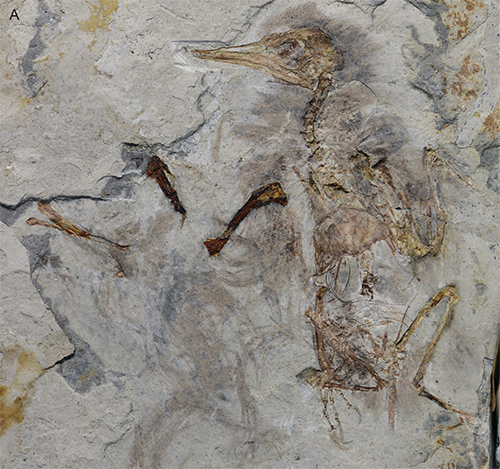 Fossil slab containing Chromeornis holotype STM7-156.
